
ROI / SIEM Cost Savings
Cut your SIEM bill. Keep every log.
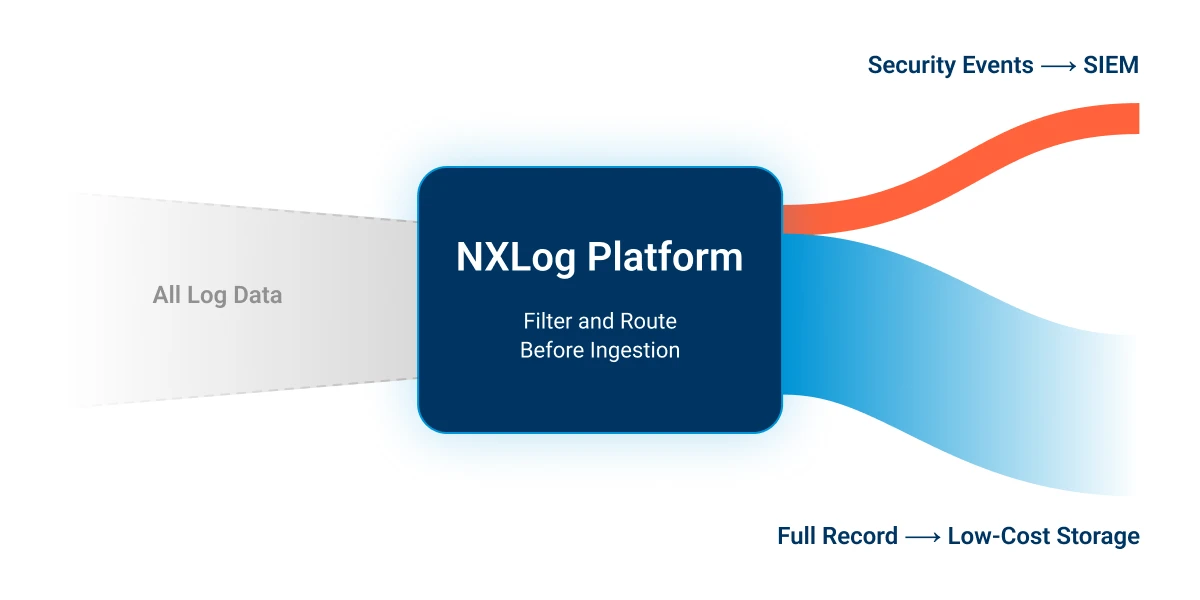
NXLog Platform sits in front of your SIEM and filters, trims, and routes telemetry before ingestion. The events that matter reach your SIEM; everything else goes to low-cost storage. Full record kept, no detection-tier prices for data you never query.
The Challenge
Where the SIEM money actually goes
Ingestion pricing punishes collection.
Whether your SIEM charges per gigabyte per day, per event per second, or by resource consumption, the principle is the same: your bill tracks how much you send, not how much value you get. A new log source, a busy day, a noisy device — the bill follows.
Most of what you ingest is never queried.
A large share of enterprise log volume is low-value telemetry kept "just in case" — verbose fields, duplicate events, health-check chatter. It costs the same per gigabyte as the events your SOC actually investigates.
"Collect less" breaks compliance.
DORA, PCI DSS, SOX, and your own audit requirements expect a complete, retained record. You can't drop logs to save money and then explain the gap to an auditor.
The noise has an operational cost too.
Flooding the SIEM with low-value events doesn't just inflate the bill — it buries the alerts that matter and slows search.
THE SOLUTION
Separate the cost of collecting from the cost of detecting
NXLog Platform is a telemetry pipeline in front of your SIEM. It collects from every source, then filters, trims, and routes the data before anything is ingested. High-value security events go to the SIEM. The full record goes to lower-cost retained storage, complete and timestamped for audit. Noise gets reduced or dropped at the edge, before it crosses the network.
Where the savings come from
Filter before ingestion
- Drop duplicates, health-check chatter, and events with no investigative value at the source.
- Every event filtered is volume your SIEM never bills.
Trim and deduplicate what remains
- Strip verbose descriptive fields and repeated metadata; keep the data that drives detection.
- Every trimmed event is smaller before it's billed — and that compounds across millions of events a day.
Route by value
- Security events to the SIEM; the full record to low-cost storage; copies to a data lake if you need them.
- You stop paying detection-tier prices for retention-tier data — and stay audit-complete.
Process at the edge
- Filter, transform, and compress close to the source, before data crosses the network.
- Less bandwidth, less central processing, less infrastructure spend.
Pay per source, not per gigabyte
- NXLog Platform pricing tracks the number of systems you collect from.
- A volume spike on an existing source doesn't change what you pay. Budgets become plannable.
THE MATH
What the reduction does to the bill
The mechanics are simple: on ingestion-based pricing, the bill tracks volume — so volume removed before ingestion comes straight off the bill.
of events filtered at the endpoint before reaching security systems
QNB FINANSBANK
log sources on one pipeline — SIEM volume reduced enough to relieve system bottlenecks and prevent SOC downtime, with the full record retained locally for audit
A TOP-10 U.S. BANK
What that means for your bill depends on your sources, your SIEM's pricing model, and how much of your current volume is noise — which is usually more than teams expect. Bring your daily volume to a demo and we'll model it against your own numbers.

The entire telemetry pipeline becomes both powerful and easy to maintain with NXLog. We value its high level of configurability and advanced log processing engine, which enables us to filter out up to 80% of events directly at the endpoints. This ensures that only the most relevant data is fed into our security systems, streamlining security operations.

Cybersecurity is an evolving thing, and facing the need to migrate from one SIEM solution to another, we found it very easy to accomplish with NXLog. Autonomous telemetry pipeline powered by NXLog allowed us to switch between security monitoring platforms without much reconfiguration and save costs.
Model it on your own volumes
Follow us



© Copyright NXLog Ltd.