
A U.S. university hospital cut log noise and sped up threat detection across thousands of systems
With NXLog Platform, the hospital closed visibility gaps across clinical, administrative, and research systems, delivered higher-value data into Google SecOps, and made HIPAA audit evidence easier to produce.

Business Demand
Keep patient data protected without interruption, detect and respond to threats quickly, stay ready for HIPAA audits, and get more out of the security tools already in place.
Key Challenges
Thousands of systems across clinical, administrative, and research domains, disparate log sources leaving blind spots, shifting regulatory demands, and noisy data holding back security analytics.
Results
Unified log visibility, faster detection and response, audit evidence on demand, and a pipeline that scales with the estate.
NXLog allowed us to simplify log collection and telemetry management across a complex healthcare IT environment, while giving us full visibility and faster threat detection. With NXLog Platform, we can leverage the full power of the Google SecOps SIEM.
— University Hospital Security Team

The Challenge
The hospital is a nonprofit academic medical center that combines patient care, research, and education on one campus. Its IT estate runs to thousands of systems across clinical, administrative, and research domains, and every one of them produces logs.
That volume was the problem. Log data arrived from many disparate sources in many different formats, and the security team had no single place to see it. The gaps between those sources became blind spots, and blind spots limited what the team could monitor and detect.
In healthcare, that lag carries real weight. A delay in spotting an incident is a delay in containing it, and containment affects patient safety as much as it affects data. Regulation adds a second demand: the HIPAA Security Rule’s audit controls standard requires mechanisms that record and examine activity in systems holding electronic protected health information, and the hospital’s existing setup could not produce that evidence consistently.
The team had already invested in Google SecOps. To get the full value from it, they needed data arriving clean, structured, and enriched rather than raw and noisy — and they needed to do that without paying to ingest data that would never be used.

The Solution
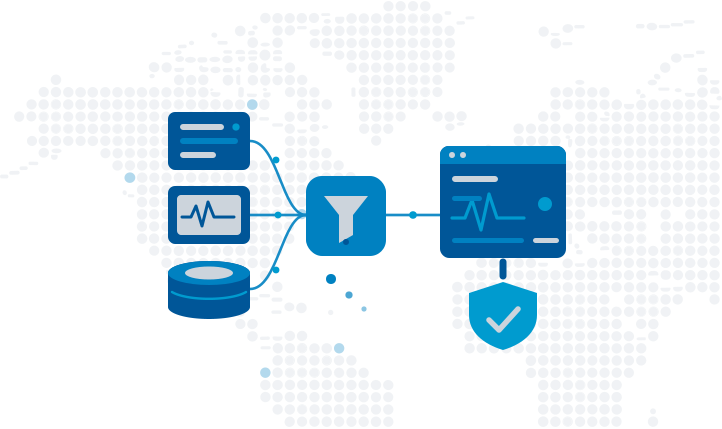
The hospital chose NXLog Platform to build one telemetry pipeline that collects, refines, and routes log data before it reaches Google SecOps.
NXLog Agent was deployed across the hospital’s Windows and Linux servers, with collection configured for Active Directory domain controller security events and PowerShell activity alongside standard system and application logs. Clinical, administrative, and research systems now feed the same pipeline, which is what closed the blind spots between them.
Processing happens at the source. Records are filtered to drop what has no security value, normalized into consistent formats, and enriched with context before they leave the host. Only data worth analyzing reaches the SIEM, which keeps the analytics layer fast and ingestion volume in check.
Delivery into Google SecOps runs through NXLog Agent’s om_chronicle output module, which sends records to the Google Security Operations Ingestion API in either unstructured or UDM format. The security team gained real-time correlation and faster investigation without adding another moving part to manage.
In a 24/7 clinical environment, staying up matters as much as staying clean. NXLog Agent uses log queues and flow control by default, so a blocked output or a network interruption suspends processing rather than dropping records. Where a log source cannot afford a gap, persistent disk-backed queues can be switched on.
NXLog Professional Services worked with the hospital’s team on the pipeline design and rollout.
Why it Worked

One agent across Windows, Linux, Active Directory, and PowerShell sources

Filtering, normalization, and enrichment before data leaves the host

Native Google SecOps delivery through the om_chronicle module

Queues and flow control built to hold the line under peak load
Results
With every critical system feeding one pipeline, the security team got a single view of the hospital’s log data for the first time. Anomalies that used to hide in the gaps between sources became visible, which moved the team from reacting to incidents toward catching them early.
Cleaner data changed how the SOC works. Analysts investigating an alert in Google SecOps now start from normalized, enriched records instead of raw text, so less of each investigation is spent working out what a log line means.
Compliance work became easier to evidence. The pipeline produces consistent audit trails across the systems that handle electronic protected health information, so the hospital can show an auditor what was recorded and reviewed rather than assembling it after the request arrives.
Filtering at the source also took pressure off the SecOps bill. Google SecOps prices ingestion against a subscription allowance, so every gigabyte of low-value data the pipeline drops is allowance the hospital keeps for telemetry that matters.
The architecture leaves room to grow. As the estate changes, new log sources join the existing pipeline rather than requiring a new one.

Unified visibility
One view across clinical, administrative, and research log sources
Faster detection and response
Analysts start investigations from normalized, enriched data
Audit evidence on demand
Consistent audit trails across the systems that handle ePHI
Controlled ingestion cost
Low-value data is dropped before it reaches Google SecOps
About the customer
The customer is a nonprofit academic medical center in the United States. It combines patient care, clinical research, and health sciences education, and its IT estate spans clinical, administrative, and research systems.
Follow us



© Copyright NXLog Ltd.