
A Filebeat alternative built for security teams
Collect once. Deliver anywhere.
Your log shipper shouldn't pick your SIEM. NXLog Agent collects security telemetry across your whole estate and delivers it to Splunk, Microsoft Sentinel, Google SecOps, OpenSearch, Elastic — or several of them at once.
Fortune 500 companies trust NXLog





Filebeat vs. NXLog Platform at a glance
Run NXLog Platform next to Filebeat and compare coverage
Why teams choose NXLog Platform

Deliver to the SIEM you chose
Filebeat writes to the Elastic Stack — one output at a time, and since 7.13 it refuses OpenSearch and other forks. NXLog Agent routes events to Splunk, Microsoft Sentinel, Google SecOps, OpenSearch, or Elastic — several destinations in parallel.

One agent instead of a Beats lineup
Beats coverage grows by installing more Beats: Winlogbeat for Event Log, Auditbeat for file integrity, Packetbeat for traffic — each its own install and upgrade cycle. NXLog Agent collects all of it, plus Registry, databases, and Linux Audit, as one agent.

Windows depth past the inputs
Filebeat added ETW and winlog inputs — the latter in beta, outside the support SLA. NXLog Agent's supported Windows stack goes further: WEF collector mode for agentless hosts, even on a Linux collector, plus Registry and file integrity monitoring.

Management without a stack migration
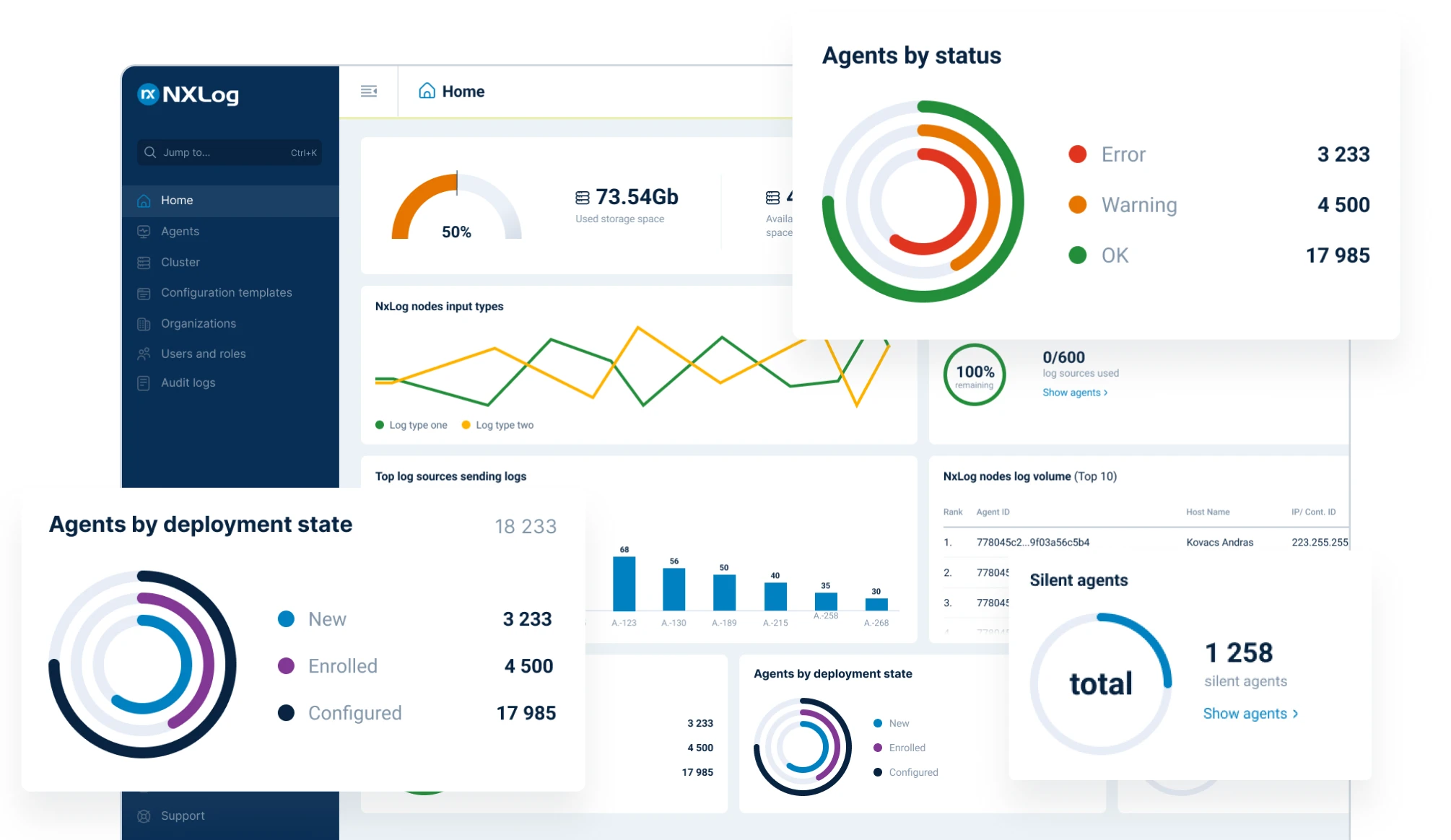
Beats have no central management — Elastic's documented path is migrating to Elastic Agent and running a Fleet Server inside the stack. NXLog Platform manages agents wherever your logs land: enrollment, configuration, monitoring, and updates for up to 100,000 agents per node.

Keep Filebeat where it earns its place
Tailing app logs into your own Elasticsearch cluster? Filebeat does that well — keep it. Run NXLog Agent where Filebeat stops: Windows depth, compliance scope, legacy Unix, and every destination that isn't Elastic. Both can feed the same index.

Trim ingest before it bills you
Filebeat leaves heavy parsing to ingest pipelines or Logstash, after events have crossed the wire. NXLog Agent parses, filters, and rewrites at the source — extensible in Perl, Python, Ruby, Java, or Go — so your SIEM ingests signal, not noise.
Planning a rollout? Book a short migration workshop
Value by Team

SecOps Engineer
Send Windows telemetry to Microsoft Sentinel, firewall logs to Splunk, and an archive copy to OpenSearch — from the same agents, with no Logstash layer to babysit.

Detection Engineer
Build rules on events that arrive whole: every Event Log field, ETW providers, PowerShell activity, and wire data — shaped at the endpoint, not after indexing.

Compliance & GRC Owner
Cover FIM and audit-trail mandates with the collection agent you already run: integrity monitoring on Windows and Linux hosts, encrypted transport, and retention under your control.

Security Architect
Keep your exit options open: a collection layer that outlives SIEM decisions, runs from Windows to AIX, deploys on-premises, and puts no vendor gate between your agents and your data.
What you get with NXLog Platform
One agent, from Windows to AIX
Supported packages for Windows, Linux, macOS, FreeBSD, AIX, and Solaris, on x86/x64, ARM, and PowerPC — no self-compiled builds, no unsupported platforms.
The Windows stack, fully supported
Every Event Log field, ETW providers, collector mode for Windows Event Forwarding, Registry watching, and performance counters — supported modules, not beta inputs.
Sources a SOC actually needs
Integrity events from files, capture off the wire (ICS protocols included), rows from ODBC databases, Check Point OPSEC LEA, Linux Audit, and the macOS unified log — collected without extra tooling.
Processing where the data is born
Parse syslog, JSON, XML, CSV, and key-value pairs at the source, drop the noise, and mask what regulations require. Custom logic runs in Perl, Python, Ruby, Java, or Go.
Agents managed at scale
Bring a new agent online in minutes, push configuration changes fleet-wide, watch health from one console, and control who touches what with RBAC and audit trails — up to 100,000 agents per node.
Retention on your terms
High-compression storage, fast search, and dashboards ship with the platform. Keep a copy outside the SIEM, cut hot-tier costs, or run analytics with no SIEM at all.
Try NXLog Platform for free
FAQs
Yes, for the core job: tailing files, receiving syslog, and forwarding Windows events. NXLog Agent reads the same sources and writes to Elasticsearch and Logstash, then adds file integrity monitoring, Registry monitoring, packet capture, WEF collector mode, and database collection. Most teams switch host by host rather than all at once.
Yes. Both write to Elasticsearch, so a phased rollout keeps existing dashboards and detections intact. NXLog Agent can also mirror the same stream to a second platform while you evaluate.
Yes. NXLog Agent sends to OpenSearch through its REST API with no genuine-Elasticsearch gate — the connection check that stops Beats 7.13 and later doesn't exist in NXLog. The same applies to any Elasticsearch-compatible backend.
Not with NXLog. Enrollment, configuration, health monitoring, and updates ship inside NXLog Platform. With Beats there is no central management — the vendor's documented path is migrating to its newer agent and running an extra management server inside the Elastic Stack.
Windows Event Forwarding collector mode — NXLog Agent is the collector, on Windows or Linux — plus Registry change monitoring and file integrity events, from the same agent that reads Event Log channels and ETW providers. In the Beats family, those jobs belong to separate agents or stay uncovered.
Splunk, Microsoft Sentinel, Google SecOps, Elastic, OpenSearch, and any syslog, HTTP(S), or Kafka destination — several at once when you want a SIEM feed plus an archive copy. Retention outside the SIEM is covered too: storage and analytics are part of the platform.
Filebeat, Beats, Elasticsearch, Logstash, Kibana, and Elastic are trademarks of Elasticsearch B.V., registered in the U.S. and in other countries. OpenSearch is a trademark of its respective owner. Product information is based on publicly available documentation as of July 2026.
Follow us



© Copyright NXLog Ltd.