
A Logstash alternative
One telemetry pipeline. Complete control.
Collect from anywhere, process, store, analyze, and route all your telemetry data (logs, metrics, traces) with a single, cross‑platform agent pipeline. NXLog Platform eliminates the need for multiple log shippers or heavy middleware, delivering end-to-end log management in one lightweight solution.
Fortune 500 companies trust NXLog





Logstash vs. NXLog Platform at a glance
Replace Logstash with NXLog Platform
Why teams choose NXLog Platform

Integrates with your stack (yes, even Elastic)
NXLog is vendor‑agnostic and works with any SIEM, analytics, or observability platform. It can forward logs in JSON, syslog, or other formats directly to Elasticsearch, Splunk, Datadog, or your tool of choice. This means you can drop NXLog Platform into your existing workflow without changing your downstream systems – or use NXLog’s built-in storage alongside them for additional analytics.

One agent for all sources (no more Beats)
Logstash environments often require a swarm of specialized shippers on each host. NXLog Platform replaces Filebeat, Winlogbeat, etc., with one cross-platform agent that collects everything – files, Windows Events, Syslog, databases, and more. You’ll reduce maintenance overhead and avoid installing Java on every machine. Even on Windows, NXLog Platform captures event logs natively (including ETW providers) so you don’t need separate forwarders.

High performance, small footprint
NXLog Plaform’s multi-threaded, event-driven architecture delivers blazingly fast throughput while using minimal CPU and memory. Written in C/C++, it easily handles tens of thousands of events per second on modest hardware. Teams running NXLog Platform note the significantly lower resource usage compared to Logstash’s JVM processes, especially on underpowered or VM environments. In short – more logs, less lag, and no Java headaches.

Enterprise-grade security & resilience
Designed for mission-critical logging, NXLog Platform includes built-in features to prevent data loss and unauthorized access. It supports encrypted transport (TLS/SSL) on every route, role-based access control and tamper-proof audit logs on the management console, and file integrity monitoring (FIM) and PII data masking at the agent. Moreover, buffering and failover are native capabilities: if a destination is down, NXLog Platform will queue or reroute data automatically to avoid outages. This reliability is baked in end-to-end, so you don’t need to bolt on third-party queues.

Flexible routing to multiple destinations
Many teams choose NXLog Platform for its ability to easily “fan-out” data. A single NXLog agent can take an event and send it to several different systems at once – for example, to an Elastic stack, a security data lake, and a backup archive in parallel. There’s no need for multiple pipeline stages or custom plugins to duplicate streams. This empowers security and operations teams to share the same data without building separate collectors, simplifying your architecture.

Built-in analytics and storage (optional)
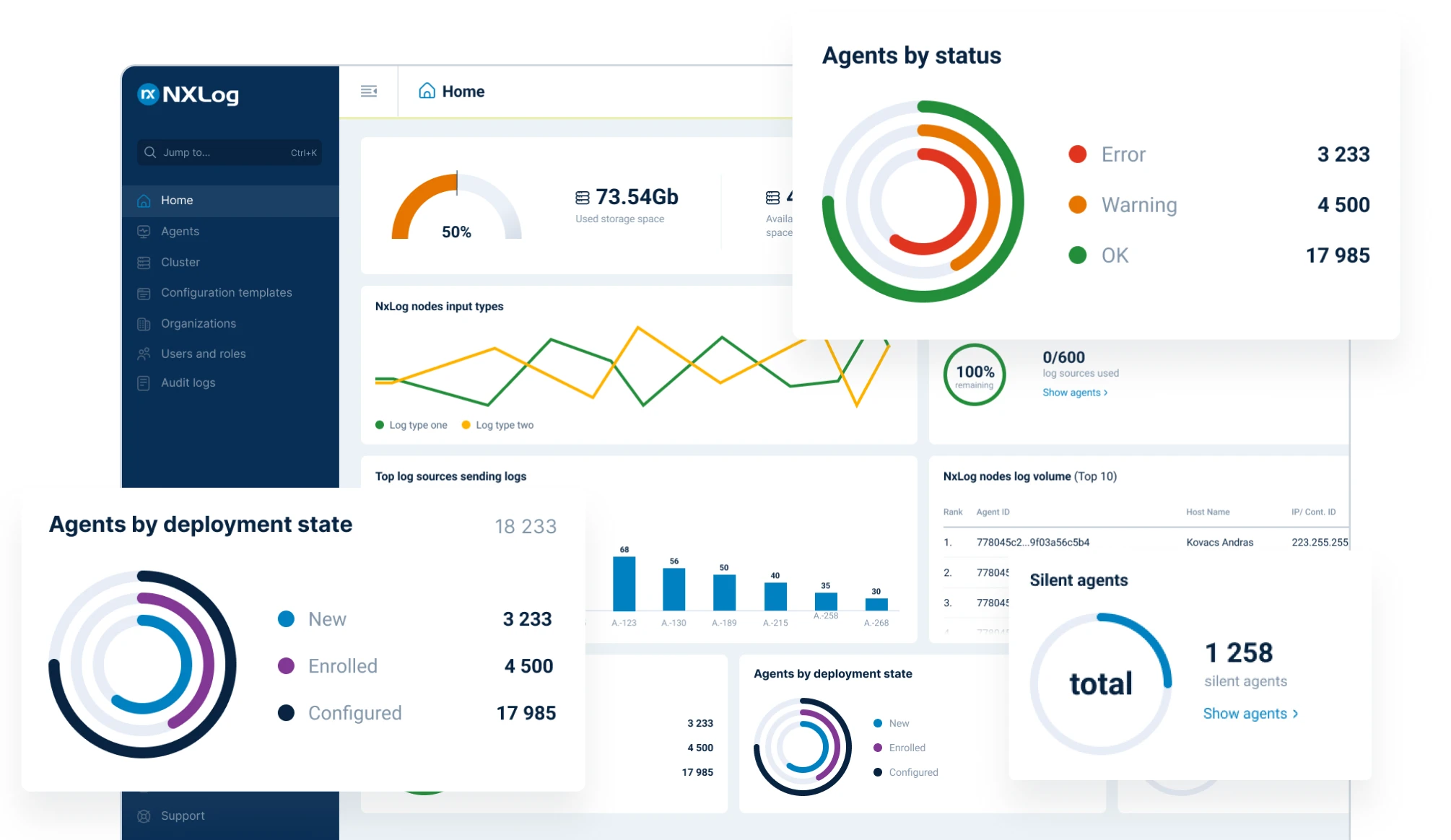
Beyond being a log shipper, NXLog Platform offers full log management capabilities. It includes a scalable storage backend and a search/query interface for analyzing logs. You can retain data with high compression, run SQL-like queries, and build dashboards – all within NXLog – reducing dependence on external databases or SIEMs. Use it to complement your existing analytics tools, or as an all-in-one solution in environments where deploying a full ELK stack is impractical. Either way, you’ll have greater flexibility in how you store and use your log data.
Need help? Book a short migration workshop
Value by Team

Platform/Observability Engineer
Deploy one agent across every OS for consistent collection and processing.
Transform at the edge (parse, enrich, normalize) to reduce central load.
Route the same stream to multiple tools without custom glue.
Accelerate root cause analysis with structured data and real-time health.

DevOps/SRE
Cut alert noise with precise filters, thresholds, and suppression at source.
Keep pipelines resilient with buffering, retries, failover, and load balancing.
Shorten MTTR using fast search, correlation, and clean event context.
Reduce operational toil by retiring extra shippers and JVM tuning.

Cloud/Infra Engineers
Cover on-prem, hybrid, and multi-cloud with agent-based or agentless collection.
Fan out from a single route to several cloud and on-prem destinations in parallel.
Run efficiently on VMs, containers, and edge hosts with a small footprint.
Automate rollouts via templates, CI/CD, and config-management tooling.

Platform Owner / IT Architect
Govern at scale with centralized control, RBAC, and audited changes.
Standardize policies for routing, retention, and access to curb tool sprawl.
Optimize spend through selective forwarding, compression, and tiered storage.
Operate confidently at enterprise scale with fleet telemetry and version hygiene.
Try NXLog Platform for free
FAQs
For the vast majority of Logstash use cases (centralizing system and application logs, parsing, and forwarding), NXLog Platform can ingest and forward the same data – then go even further with cross-platform collection, edge processing, secure transport, built-in storage, and centralized management. In many setups, you can simply deploy NXLog agents and send logs directly to Elasticsearch (or any datastore), eliminating the need for Logstash altogether.
Absolutely. NXLog Platform is tool-agnostic – it integrates with any log analytics or SIEM stack. You can send data to Elasticsearch, Splunk, Datadog, or whatever platforms you already rely on. NXLog Platform outputs logs in standard formats (JSON, syslog, etc.), so your existing dashboards and alerting will continue to work. Think of NXLog Platform as a powerful upgrade to your log shipping layer, not something that forces you to change your whole monitoring ecosystem.
No. NXLog Platform is an all-in-one log collector. One NXLog agent on a host can replace Filebeat, Winlogbeat, Packetbeat, and others by itself. It handles files, Windows Events, Linux syslog, network device logs, cloud services – all within one configuration. This means fewer agents to install and manage, and a unified config syntax across all log sources. You’ll spend less time maintaining multiple tools and more time on analysis.
NXLog Platform was designed with Windows in mind (unlike traditional Linux-focused tools). It uses a native module (im_msvistalog) to tap into Windows Event Log channels (Application, System, Security, etc.) and even supports Event Tracing for Windows (ETW) for low-level kernel or application events. In practice, NXLog Platform can collect anything Windows logs without needing a separate “event log forwarder” service. This native approach preserves full event details (rendered XML, enrichment, etc.) that might be lost if you relied on syslog or third-party converters.
Yes – NXLog Platform is built for highly scalable, reliable performance. Its architecture supports thousands of agents and extremely high event rates on the server side. Out of the box, NXLog Platform includes failover mechanisms, load-balancing across multiple destinations, and buffering (spooling to disk or memory) to handle backpressure. If a network link or target system goes down, NXLog Platform will queue data and/or switch to a secondary route automatically. This ensures you won’t lose logs during outages, and you won’t overload any single consumer. In terms of scalability, large deployments (tens of thousands of endpoints) are managed through the central NXLog Platform with template configs and group policies, making expansion straightforward. In short, it’s ready for enterprise scale and resilience from day one.
Logstash is a trademark of Elasticsearch BV. Product information is based on publicly available documentation as of November, 2025.
Follow us



© Copyright NXLog Ltd.